
Once your budget is settled, the real question is how to spend it. Two diamonds bought for the same money can look remarkably different on the hand, and the difference comes from knowing where the eye notices quality and where it only shows up on the certificate. Here is how to get the best diamond for your budget: where to compromise, and where never to. (If the figure itself is still open, start with how much to spend on an engagement ring.)
Cut: the one place you never compromise
Cut is the only one of the four Cs that decides how a diamond behaves in light. A well-cut stone returns light as brightness and fire; a poorly cut stone of the same weight leaks it and looks smaller and duller. No colour or clarity grade can rescue a weak cut, while a great cut hides a little warmth and small inclusions behind its sparkle.
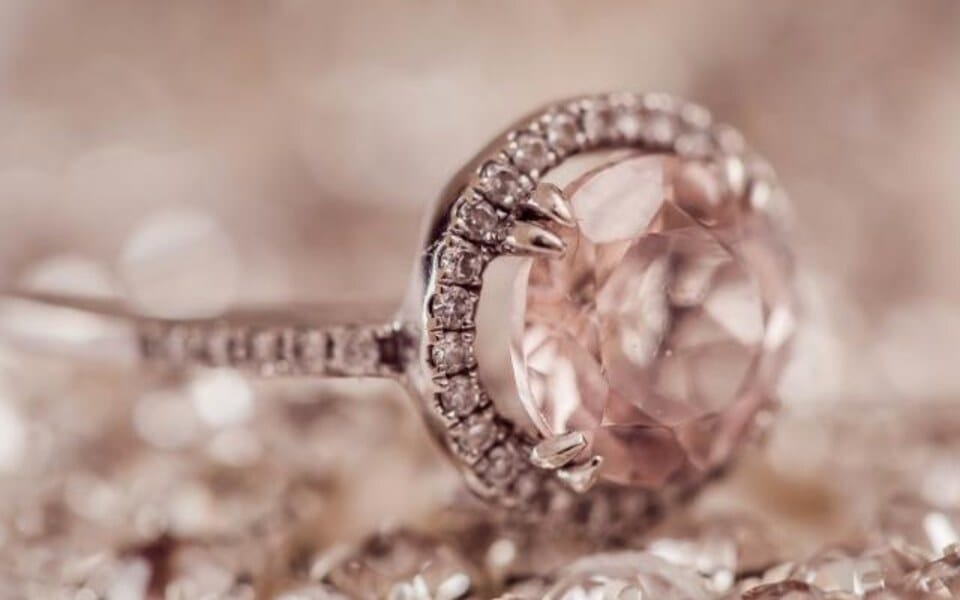
For a round diamond, aim for an Excellent cut grade. The best Very Good stones can match it to the eye, but only the stone itself tells you which; our comparison of Excellent and Very Good cut grades explains why. Fancy shapes carry no overall cut grade, so judge their light return on the 360° video.
Colour: near-colourless, not colourless
The top grades, D, E and F, are rare and priced accordingly, yet once a diamond is set very few people can tell an F from a G or an H. That makes G and H the sweet spot in white gold or platinum: they face up white and cost noticeably less.
In yellow or rose gold, the logic moves further down the scale. Warm metal surrounds the stone with colour, so an I or J reads white against it, and paying for a D would buy a difference the setting erases. Our colour and clarity chart goes grade by grade, and our yellow gold engagement rings show the pairing on the hand.
Clarity: pay for eye-clean, not for the microscope
Clarity is graded under ten times magnification, which is not how anyone wears a ring. What matters is the naked eye, and there nearly every VS2 is eye-clean, as are many SI1 diamonds.
The grade alone does not tell you which SI1 is the clean one: that depends on what the inclusion is and where it sits. This is why we film every stone in 360° and send the video with the certificate on WhatsApp, so you can check for yourself. Our guide to eye-clean diamonds explains what to look for.
Carat: buy just under the magic numbers
Prices step up sharply at round weights: half a carat, three quarters, one carat, one and a half, two. Visible size does not. A well-cut 0.90 carat round measures about 6.2 mm across against about 6.5 mm for a full carat, a difference nobody notices on the hand, yet the lighter stone sits below the threshold and costs meaningfully less. The same applies to 0.45 against 0.50, 1.40 against 1.50 and 1.90 against 2.00.
Watch proportions too: a stone cut too deep hides weight underneath, where you pay for it but never see it. Our carat and size guide shows how each weight translates into width on the finger.
Shape: choose one that looks larger per carat
Round brilliants are the most expensive shape per carat, partly because cutting one sacrifices more of the rough crystal. Oval, pear and marquise spread their weight across a longer outline, so they look larger than a round of the same weight and flatter the finger too.
One thing to check: many elongated stones show a darker band across the middle, known as a bow-tie. A faint one is normal, a strong one is not, and you will spot it at once on video. See our oval diamonds in stock, read the oval cut guide, or compare every outline in our diamond shapes guide.
Fluorescence: the discount hiding in plain sight
Fluorescence is a diamond’s reaction to ultraviolet light. The market discounts it, yet in ordinary light it is almost always invisible, so faint or medium fluorescence in a G to J stone is often a genuine opportunity; a soft blue glow can even help it face up a touch whiter. The exception is strong or very strong fluorescence in the top colours, where a minority of stones look slightly hazy. Our note on diamond fluorescence has the detail.
Setting: let the ring add size
The setting is the last lever, adding presence without touching the diamond.
- A halo frames the centre stone in small diamonds and makes it read larger. See our halo engagement rings.
- A slim band makes the same stone look bigger by contrast; a heavy band does the opposite.
- Four claws rather than six show slightly more of the diamond.
- A hidden halo adds sparkle in profile while keeping a clean solitaire look from above.
Our guide to setting styles compares them side by side.
Certification: the one line where saving costs the most
Never economise on the certificate. A grade is only as reliable as the laboratory behind it, and a generously graded stone can look like a bargain on paper while sitting a grade or two lower in reality. We sell only GIA or HRD certified diamonds. Our comparisons of GIA and HRD and GIA and IGI explain why the laboratory matters, and the half-price diamond shows what happens when it is ignored.
Where to compromise, and where not to
| Factor | Where you can save | Where you should not |
|---|---|---|
| Cut | Nowhere: this is the one to protect | Anything below Excellent on a round, unless you have seen the stone |
| Colour | G to H in white metal; I to J in yellow or rose gold | Warmer grades in white metal if you are sensitive to tint |
| Clarity | VS2 or SI1, confirmed eye-clean on video | SI2 bought on the grade alone |
| Carat | Just under round weights: 0.90, 1.40, 1.90 | Deep-cut stones that hide their weight |
| Shape | Oval, pear or marquise for more visible size | An elongated stone with a strong bow-tie |
| Fluorescence | Faint or medium in G to J colours | Strong or very strong in D to F, unseen |
| Setting | A halo or slim band for extra presence | A heavy mount that swallows the stone |
| Certificate | Nowhere: GIA or HRD only | Any report you cannot verify online |
See what each budget band buys
To see these priorities at work, browse by budget band on our loose diamonds page. Start with our entry budget band, move up to the second band or the third band, or go straight to our top budget band. Within any band, compare cut first.
Common questions about getting the best diamond for your budget
What should I prioritise when buying a diamond on a budget?
Cut first, always; then choose the lowest colour and clarity grades that still look white and clean to the naked eye, and put what you save into a larger or better-cut stone.
Is it better to buy a bigger diamond or a higher quality one?
Usually the best answer is a well-cut, near-colourless, eye-clean stone as large as those choices allow, because top colour and clarity grades add a rarity you cannot see, while a larger well-cut diamond is something you notice every day.
What is the best colour and clarity for the money?
For most rings in white gold or platinum, G or H colour with VS2 or an eye-clean SI1; in yellow or rose gold, an I or J colour works beautifully.
Does a 0.90 carat diamond look smaller than a 1 carat?
Not to the naked eye: a well-cut 0.90 carat round is only about three tenths of a millimetre narrower than a full carat, yet it sits below the one-carat price step.
Which diamond shape looks biggest for its weight?
Elongated shapes such as marquise, oval and pear show the most surface for their weight, so they look larger than a round diamond of the same carat.
Find the best diamond your budget can buy
You do not need to spend more to get a better-looking diamond, only to spend in the right places. Browse our certified loose diamonds, build your ring around the one you choose, or message us on WhatsApp with your priorities and we will send the 360° videos and certificates of the stones that fit.