
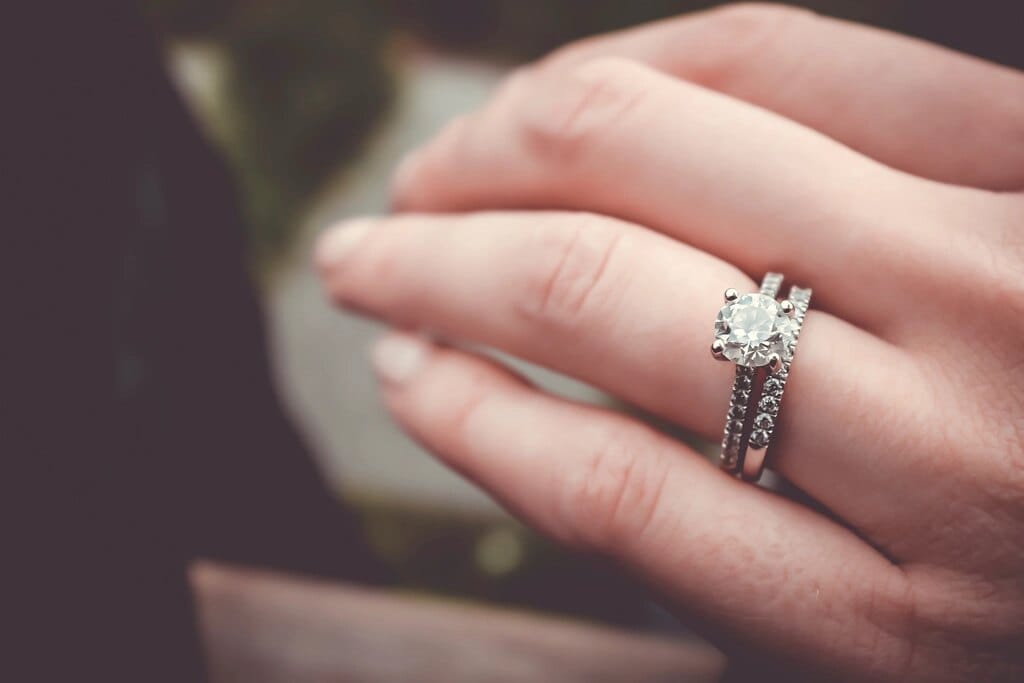
Carat is a unit of weight, not size. Two stones of identical weight can look very different across the finger, and a lighter stone can read larger than a heavier one. In the Beirut diamond trade, this is the single point we most often have to untangle for a couple choosing a ring. To see these sizes on real stones, compare our half carat diamonds, 1 carat diamonds and 2 carat diamonds, each filmed in 360° in Beirut.
What the carat actually measures
One carat is a fifth of a gram, a measure of mass, settled long ago so that the trade could speak one language. It tells you nothing directly about how wide the diamond will appear when it sits on the hand. What the eye sees is the face-up diameter: the width of the stone as you look down on it. Weight and face-up size move together, but loosely, and the gap between them is where most of the surprises live.
Face-up diameters for common round weights
For a well-cut round brilliant, the everyday weights translate roughly to these face-up diameters:
- 0.50 ct, about 5.1 mm
- 0.70 ct, about 5.7 mm
- 0.90 ct, about 6.2 mm
- 1.00 ct, about 6.5 mm
- 1.50 ct, about 7.4 mm
- 2.00 ct, about 8.1 mm
Notice that doubling the weight from 1.00 to 2.00 ct does not double the width; it adds only about a quarter to the diameter. Weight grows with volume, in three dimensions; the width you see grows far more slowly. This is why a heavier stone is never as dramatic, face-up, as the carat figure alone suggests.
Buy just under the steps
Carat has psychological thresholds, half-carat, three-quarter, one carat, two carats, and price steps up sharply at each one. The diameter does not. A 0.90 ct round sits at roughly 6.2 mm against a full carat’s 6.5 mm: a difference of three-tenths of a millimetre, invisible on the hand to any normal eye. Buy a touch under the round number and you keep almost all of the presence while stepping back from the premium the threshold commands. The trade has done this quietly for as long as the trade has existed.
Why two one-carat stones look different
Weight can hide where the eye cannot see it. A deep-cut diamond carries part of its mass down in the pavilion, below the girdle, weight you pay for but never see face-up. That stone weighs a full carat yet reads small, perhaps 6.2 mm instead of 6.5. A well-proportioned cut puts the weight where it shows and returns light to the eye. When you read a Rapaport-anchored price, cut is the quiet variable deciding whether a carat looks like a carat.
Shape matters as much. Elongated cuts, oval, marquise, pear, emerald, spread more width per carat than a round, because their outline covers more area for the same weight. A one-carat oval will look noticeably longer across the finger than a one-carat round, which is why a buyer wanting maximum size often leans that way. A round remains the most brilliant return of light; the choice is presence against fire.
The hand the stone sits on
Size is relative to its setting, and to the finger. A slender finger flatters a stone, letting a 0.90 ct read generously; a broader finger asks for more width to balance. The band plays the same trick: a fine, narrow band makes the diamond look larger by contrast, while a heavy shank can swallow it. None of this changes the certificate. It changes the impression, which is what your eye actually buys.
If presence is the goal, a halo is the honest shortcut. A ring of small diamonds around the centre stone lifts the apparent size by a full size-step or more, so a 0.70 ct centre can carry the visual weight of a full carat. We explain the trade-offs in our guide to halo and hidden-halo settings; it is a genuine way to gain face-up size without adding centre-stone weight.
Choosing with your eyes open
Decide first what you want the stone to do on the hand, then let weight follow. Favour cut, consider a shape that spreads, sit just under a threshold, and remember a clean, well-cut stone earns its size honestly, see our note on eye-clean clarity for where it is safe to save. When you are ready to compare real diameters side by side, our loose certified stones are the place to start.
Browse by size: half-carat, 1 carat, 1.5 carat and 2 carat diamonds in Lebanon.