
An Asscher is a square step cut with its corners cropped, so it reads almost as an octagon, and it trades the busy sparkle of a brilliant for broad flashes of light and a sense of depth. Because nothing hides inside those open facets, it asks more of clarity and colour than most shapes. We source Asschers on request; to choose from stones ready today, see our certified loose diamonds or start to build your ring.
How a step cut works
A brilliant breaks light into sparkle with dozens of small triangular and kite-shaped facets. A step cut does the opposite: long, flat facets run parallel to the edges in rows, like the treads of a staircase, and return light in broad, slower flashes with crisp contrast between bright and dark.
The Asscher arranges those steps in concentric squares around a fairly small table, usually with a high crown, a deep pavilion and larger cropped corners than a typical emerald cut. On a grading report it may appear under a technical name, such as square emerald cut or cut-cornered square step cut, rather than the word Asscher.
The windmill and the hall of mirrors
Look down into a well-cut Asscher and you see squares receding inside squares: the hall-of-mirrors depth step cuts are prized for. Reflections from the corner facets cross the stone diagonally and form an X with four arms, which the trade calls the windmill. On a face-up frame of the video, check that:
- the four arms meet at the centre, not off to one side;
- the concentric squares are evenly spaced, each step parallel to the one outside it;
- the four cut corners are the same size, so the outline does not look skewed;
- bright and dark steps alternate crisply rather than blurring into a grey, glassy centre.
An Asscher has no bow-tie. Ovals, pears and marquises are judged on that dark band; an Asscher is judged on its windmill.
Ratio, depth and table, in general terms
The ratio, length divided by width, should be close to 1: about 1.00 to 1.05 reads as a true square. Past roughly 1.08 most eyes see a rectangle, and the stone starts to look like an emerald cut. Both measurements are on the report (see how to read a GIA report).
GIA gives fancy shapes no overall cut grade, so proportions are worth a glance. As general guidance:
- Depth. An Asscher is meant to be fairly deep, which creates the receding squares. Too shallow, the steps wash out and the centre looks glassy; too deep, it faces up small and can look dark.
- Table. Smaller than you would find on many emerald cuts, leaving room for the stepped crown that frames the windmill.
- Polish and symmetry. Uneven steps show, so Very Good or better on both is a sensible floor.
That deep pavilion also makes an Asscher face up slightly smaller than a round of equal weight (see carat versus size on the hand).
Why clarity matters more in a step cut
The broad table and long, open facets act like a window. An inclusion that a brilliant would scatter into its sparkle can sit in plain view, especially under the table, where the eye goes first. Dark crystals show most; small feathers near the corners, where prongs may cover them, least.
As a guideline, look at VS2 or better, then judge each stone by eye on video where possible, because grade alone does not settle it: one VS2 may show nothing, another a visible spot. An SI1 Asscher that is truly eye-clean exists but is rare.
Colour shows more than in a brilliant
Fewer, larger facets also mask less body colour, so an Asscher tends to look a touch warmer than a round of the same grade. For white gold or platinum, many buyers go a grade or two whiter than they would for a round. In yellow gold, a warmer stone can look deliberate and suits the shape’s period feel. Our colour and clarity chart and our metal guide help you balance the two.
Asscher, emerald cut or princess?
Three squarish shapes are often confused; the ratios below are typical guidelines.
| Asscher | Emerald cut | Princess | |
|---|---|---|---|
| Facet style | Step cut | Step cut | Brilliant |
| Outline | Square, cropped corners | Rectangle, cropped corners | Square, sharp corners |
| Ratio | About 1.00 to 1.05 | About 1.30 to 1.50 | About 1.00 to 1.04 |
| The look | Concentric squares, windmill | Long hall of mirrors | Crisp, scattered sparkle |
| Corners | Protected by cropping | Protected by cropping | Pointed, need V-prongs |
| Pick it if… | You want depth and Art Deco symmetry | You want length on the finger | You want maximum sparkle in a square |
Read more in our emerald cut diamond guide and princess cut diamond guide.
Art Deco settings
The Asscher’s geometry belongs to the Art Deco look of the 1920s and 1930s, and the best rings lean into it.
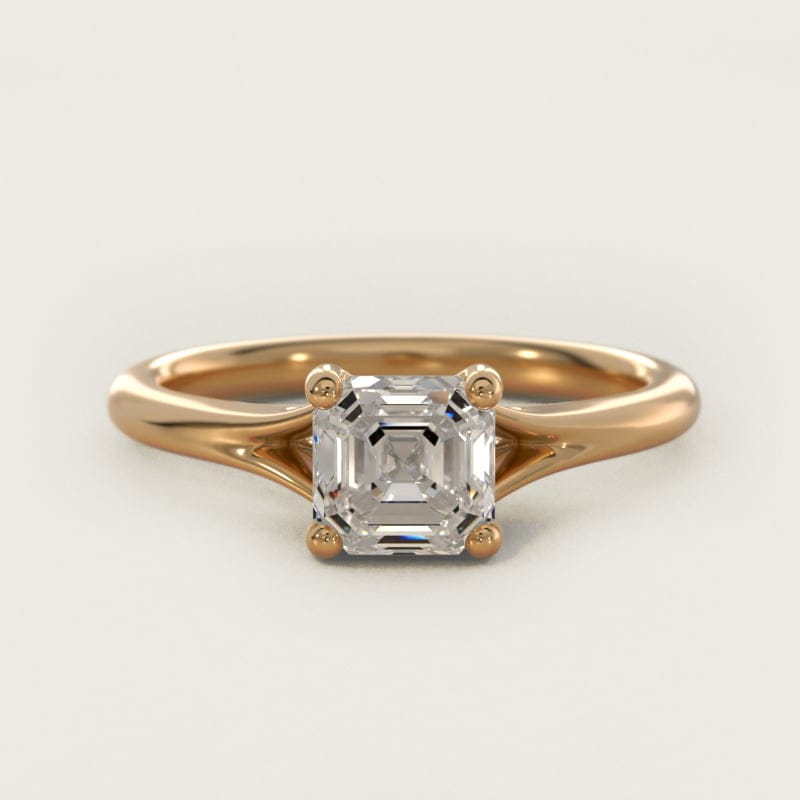
- Four-prong solitaire. One prong on each cropped corner frames the octagon and keeps the windmill clear: see our solitaire engagement rings.
- Vintage detail. Milgrain edges, engraving and an open gallery play to its period character: browse vintage engagement rings.
- Step-cut side stones. Baguettes or trapezoids beside the centre speak the same language: see side-stone engagement rings.
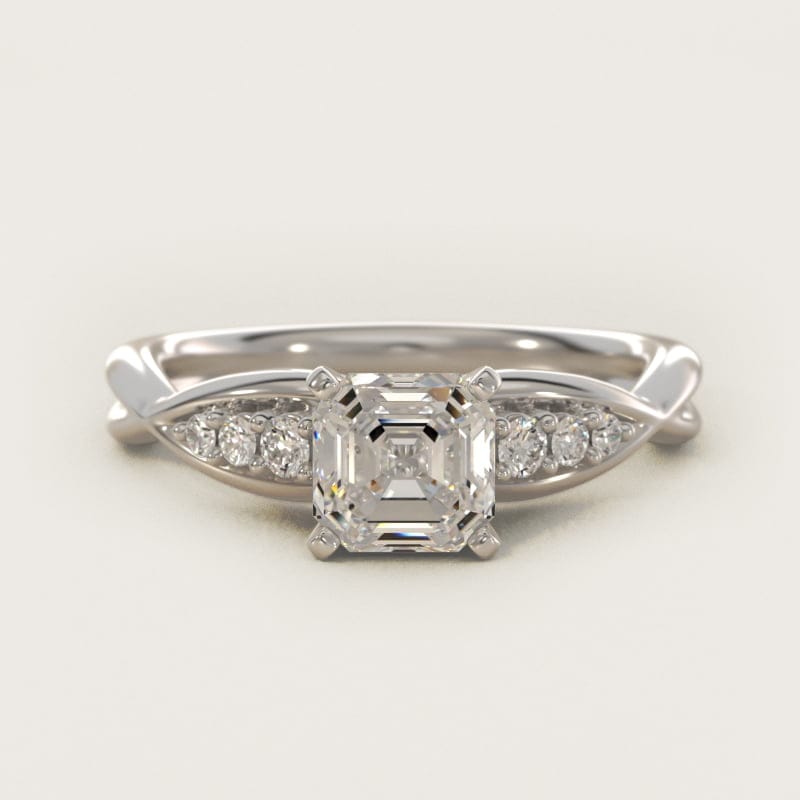
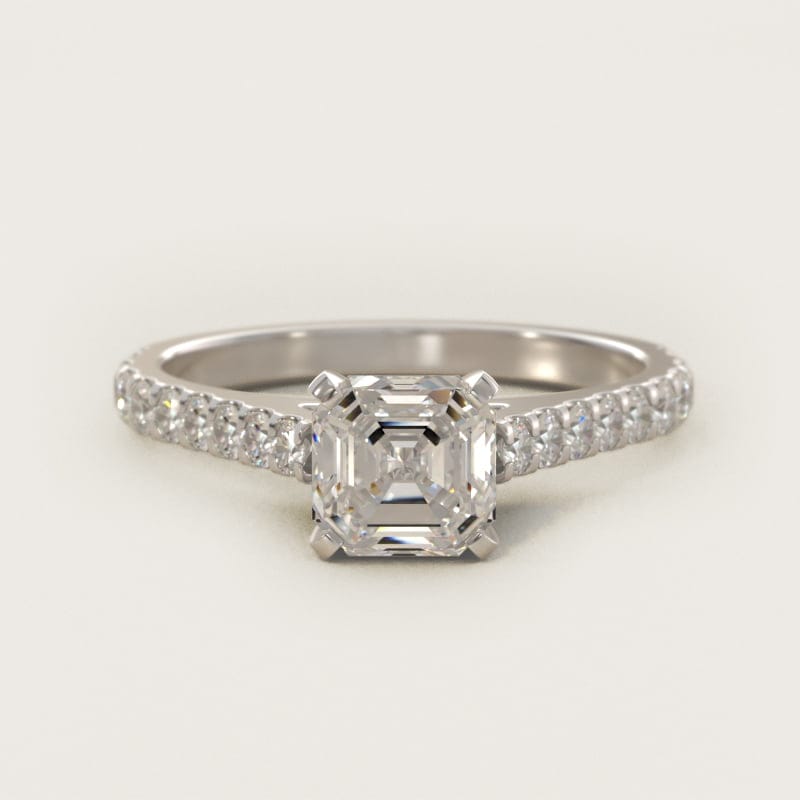
- A sparkling band. Pavé or a twisted band adds glitter around a calm centre.
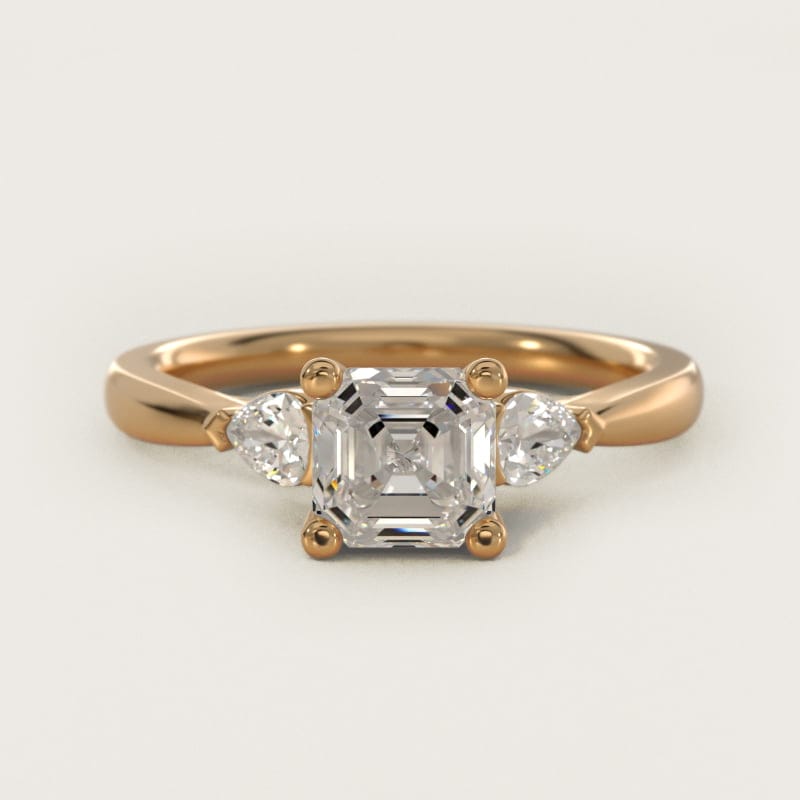
Because the corners are cropped rather than pointed, an Asscher is less exposed to chipping than a princess. Each ring is made to order in 18K gold or platinum in about a week to ten days. Designs that take an Asscher:
See all 17 settings in this style
Sourcing an Asscher through us
Asschers are not part of our Beirut stock at present, so we find one to your brief. Tell us on WhatsApp the carat range, colour, clarity and budget. We search the international diamond pipeline for natural, GIA- or HRD-certified stones, usually in 2 to 3 weeks, and say plainly when a candidate looks likely to show an inclusion under the table. Every report number can be verified on the laboratory’s website before you commit.
A deposit secures the stone you pick. The balance is settled when you collect by appointment in Beirut, or when it reaches you by free insured delivery inside Greater Beirut. Buying from abroad? See our diaspora page, and the diamond shapes guide for every other shape.
Common questions about Asscher cut diamonds
What clarity is best for an Asscher cut diamond?
As a guideline, VS2 or better, confirmed on video. Step-cut facets act like a window, so an inclusion under the table that a brilliant would hide can be plain to see. Some VS2 stones are perfectly clean to the eye and some are not, which is why the video matters as much as the grade.
What is the difference between an Asscher and an emerald cut?
Both are step cuts with cropped corners. An Asscher is square, usually with a higher crown, a deeper pavilion, a smaller table and larger corners, which creates its concentric windmill. An emerald cut is rectangular, with long open facets that run along its length like a hall of mirrors.
Is an Asscher cut diamond durable?
Yes. Its cropped corners remove the sharp points that make a princess cut vulnerable, so it is less likely to chip from a knock, and a prong on each corner holds it securely. As with any diamond, avoid a girdle described as extremely thin.
Does an Asscher look smaller than a round diamond?
Usually a little. An Asscher keeps much of its weight in a deep pavilion, and its square outline does not stretch along the finger, so it faces up slightly smaller than a round of the same carat. Compare millimetres on the reports, not carats.
Can I buy an Asscher cut diamond in Lebanon?
Yes, through sourcing. diamonds.com.lb finds natural, GIA- or HRD-certified Asscher cut diamonds to your specification, typically within 2 to 3 weeks. Send your preferred carat, colour, clarity and budget on WhatsApp; you then reserve with a deposit and collect by appointment in Beirut.