
The round brilliant is the most popular diamond shape in the world, and most of the loose stock we hold in Beirut is cut this way. This guide covers what defines a round, which grades and proportions matter, how large it looks and which settings suit it. To compare real stones as you read, see our round brilliant diamonds in Lebanon or all our certified loose diamonds.
What defines a round brilliant
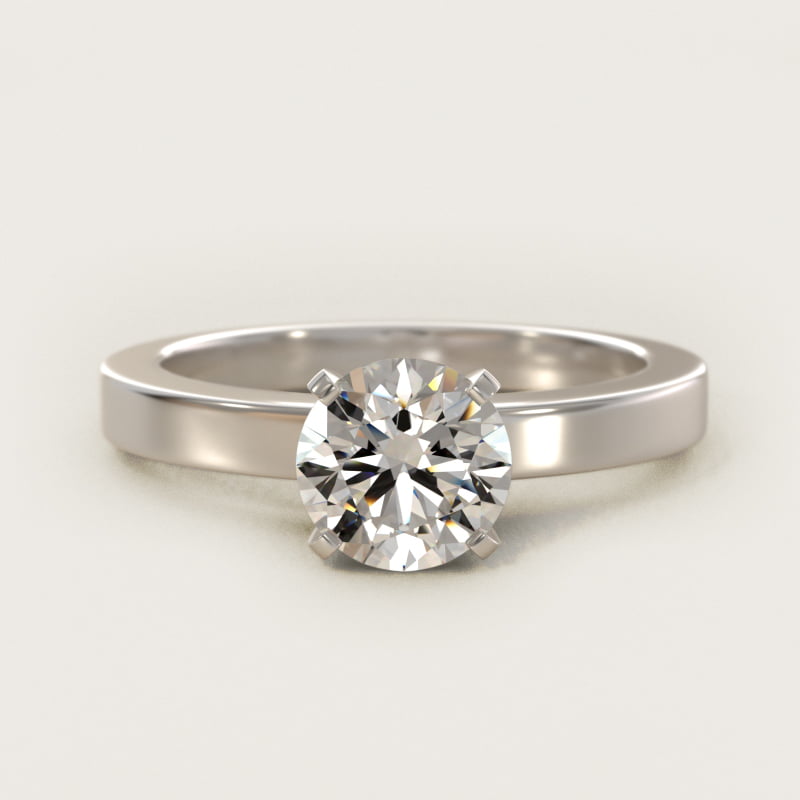
A round brilliant is a circular diamond with 57 facets, or 58 when the point at the bottom is polished into a tiny flat culet. The top half, the crown, carries 33 facets around a large central table; the lower half, the pavilion, carries 24. The girdle, the thin rim at the widest point, separates the two.
It is the only shape with one agreed facet pattern, refined over more than a century to return light as brightness, fire (flashes of colour) and scintillation (sparkle in motion). That is why it hides faint colour and small inclusions better than any other outline; it is also the shape that costs the most per carat. Our diamond shapes guide sets it beside the alternatives.
What to look for in a round diamond
Cut grade comes first
The round is the only shape GIA grades for cut: Excellent, Very Good, Good, Fair or Poor. HRD uses the same words on three lines: proportions, polish and symmetry. Excellent is the safe default from a distance; a strong Very Good can look identical to the eye, a weak one cannot, so judge it on video. Our guide to Excellent vs Very Good cut grades explains the difference.
Proportions, as typical guidance
The cut grade is built from the proportions printed on the report. Many of the best-performing rounds fall within these ranges, but they are guidance, not rules: the angles work together.
| Measurement | Typical range | Outside the range |
|---|---|---|
| Table | 53 to 58 per cent | Much larger looks flatter |
| Total depth | 59 to 62.5 per cent | Deeper faces up smaller |
| Crown angle | 34 to 35 degrees | Shallower gives less fire |
| Pavilion angle | 40.6 to 41 degrees | Off-angle leaks light |
| Girdle | Thin to slightly thick | Extremely thin chips easily |
| Culet | None or very small | Large shows as a dark dot |
A depth of 63 to 65 per cent is not unusual in a Very Good round: it faces up a little smaller for its carat, yet can still be bright, so compare millimetres as well as weight. Our guide to reading a GIA diamond report shows where each figure sits.
A round should also be nearly a perfect circle: a ratio of the two diameters up to about 1.02 looks perfectly round. Look for Very Good or Excellent polish and symmetry.
Colour and clarity in a round
The round’s brilliance disguises body colour better than any other shape. G and H usually face up white in white gold or platinum, and I or J look at home in yellow or rose gold; colour shows more in larger stones. Clarity is just as forgiving: nearly every VS2 round is eye-clean, and many SI1 stones are too. Position matters more than the letter: a feather near the girdle beats a dark crystal under the table. Our colour and clarity chart goes grade by grade.
How big a round looks on the hand
Carat is weight, not size. A round keeps a good part of its weight below the girdle, so it looks smaller face-up than an oval or pear of the same weight. Approximate diameters for well-cut rounds:
| Carat weight | Approximate diameter |
|---|---|
| 0.50 ct | 5.1 mm |
| 0.70 ct | 5.7 mm |
| 0.90 ct | 6.2 mm |
| 1.00 ct | 6.5 mm |
| 1.50 ct | 7.4 mm |
| 2.00 ct | 8.1 mm |
Doubling the weight from one carat to two adds only about a quarter to the diameter, and a 0.90 ct looks almost the same as a full carat. A fine band or a halo makes any round look larger. Our carat and size guide goes further.
Settings that suit a round
The round is the easiest shape to set and works in every style we make:
- Solitaire. Four claws show the most diamond; six give a softer outline and extra security. See our solitaire engagement rings.
- Halo. A ring of small diamonds adds visible size; a hidden halo tucks it beneath the stone. See our halo engagement rings.
- Pavé and three-stone. Small diamonds set along the band, or a smaller stone on each side: see pavé and three-stone engagement rings.
Every setting is made to order in Beirut in 18K white, yellow or rose gold or platinum. Below are round settings from our collection; browse all our engagement rings in Lebanon, or pair a stone and a setting in build your ring. If you want the round’s sparkle in a longer outline, read our oval cut diamond guide.


See all 74 settings in this style
How to buy a round diamond in Lebanon
Every round we sell is a natural diamond with a GIA or HRD report, held in Beirut and priced against the Rapaport benchmark. We send its certificate and 360° video on WhatsApp, and you can check the report number on the laboratory’s website with our verification guide. If the round you want is not in stock, we can source one to your specification, typically within 2 to 3 weeks.
Reserving requires a deposit, with the balance paid on collection. Collect by appointment in Beirut, or receive free insured delivery within Greater Beirut, typically in 24 to 48 hours (see delivery); buyers elsewhere in Lebanon or abroad collect by appointment in Beirut (see buying from abroad). A ring is made to order in about a week to ten days, or set into a ready-made mounting in 24 to 48 hours. Loose diamonds can be returned within 7 days if unset, unworn and undamaged, with certificate and packaging (see returns).
Common questions
How many facets does a round brilliant diamond have?
A round brilliant has 57 facets, or 58 when the tip of the pavilion is polished into a small flat culet. The crown carries 33 facets and the pavilion 24, arranged to send as much light as possible back through the top.
What is the best cut grade for a round diamond?
Excellent is the top cut grade on GIA and HRD reports and the safest choice, particularly when buying from a distance. A strong Very Good can look the same to the eye for less money, but the grade is a range, so judge that particular stone on its 360° video.
What depth and table should a round diamond have?
As typical guidance, many of the best-performing rounds have a total depth of about 59 to 62.5 per cent and a table of about 53 to 58 per cent. The crown and pavilion angles work together, so a stone slightly outside these ranges can still be bright.
How big is a 1 carat round diamond?
A well-cut 1 carat round brilliant measures about 6.5 mm across. A deeper stone of the same weight may measure nearer 6.2 mm and look smaller on the hand, so compare the diameter on the report as well as the weight.