The emerald cut diamond is the quiet aristocrat of the diamond world. Where a round brilliant dazzles with fire and sparkle, the emerald cut draws you in slowly, with long, mirror-like flashes and an air of composed elegance. It is a shape for those who prefer refinement over fireworks, and it has a character all its own.
What an emerald cut diamond is
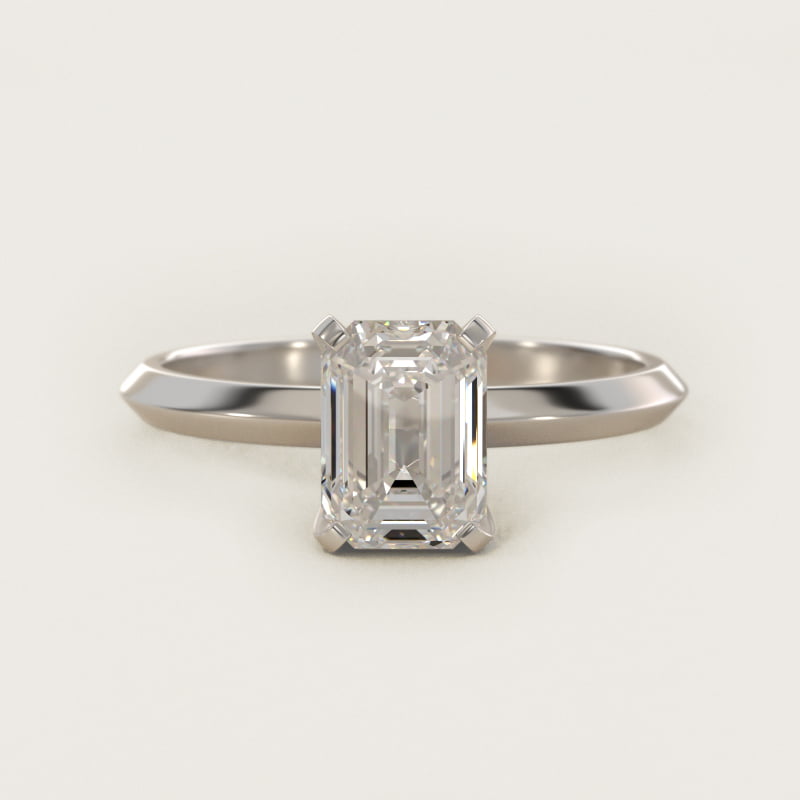
An emerald cut is a step cut, not a brilliant cut. Instead of dozens of small, triangular facets bouncing light in every direction, it has long, parallel facets that run like steps down to the table, framed by cropped corners. The result is what jewellers call the “hall of mirrors” effect: broad, rectangular flashes of light and dark that shift as the stone moves. It is a calmer, more architectural shine than the restless sparkle of a brilliant, and it shows off the natural transparency of the rough beautifully. If you are weighing it against other silhouettes, our guide to diamond shapes sets it in context.
Why clarity matters more
The emerald cut’s greatest virtue is also its greatest demand. That wide, open table acts like a window straight into the heart of the stone, so it hides nothing. Inclusions that would vanish behind the busy sparkle of a round brilliant can sit plainly in view here. This is why we always counsel choosing an emerald cut by eye rather than by grade alone.
- Look for a stone that is eye-clean clarity, free of inclusions visible to the naked eye at a normal viewing distance.
- Pay close attention to the centre of the table, where the open facets reveal the most.
- Use the 360° video and the certificate together; a clarity grade tells you what is there, the video tells you whether you will see it.
Why colour can show more
Those same open facets that expose clarity also make body colour easier to perceive. An emerald cut tends to reveal a touch more warmth than a brilliant of the same colour grade, so the choice deserves thought rather than a rule of thumb. Some buyers love a faint, candlelit warmth and choose a slightly lower colour grade with confidence; others want the stone to read crisply white and aim higher. Either is right; it is a matter of taste and of the metal you set it in. Our explainer on the 4Cs walks through how colour, clarity, cut and carat work together.
The look on the hand and the ideal ratio
Few shapes flatter a finger like an emerald cut. Its length draws the eye along the hand and lends a long, elegant line, making it a favourite for those who want presence without bulk. The proportion that governs this is the length-to-width ratio, and for a classic emerald cut we recommend aiming for roughly:
- 1.30 to 1.50, the sweet spot, balanced and timeless, neither stubby nor stretched.
- Below 1.30 the stone reads squarer and more compact; above 1.50 it grows distinctly elongated, which some adore.
- Trust your own eye against the millimetre dimensions on the report, not the carat figure alone.
Settings that suit it
The emerald cut’s clean geometry pairs naturally with settings that honour its lines. A simple solitaire lets the stone speak for itself. A three-stone design, often with tapered baguettes or trapezoids, echoes the step-cut language and amplifies that architectural feel. Slender pavé or a half-bezel can frame the long sides without crowding them. Whatever the choice, secure corners matter, since the cropped corners are where the stone meets the world. When you are ready to picture it set, you can build your ring around the stone you love.
How to buy one certified with us
Every emerald cut we offer is a natural diamond, certified by GIA or HRD, with a verifiable report you can check yourself before you commit. We show transparent Rapaport-referenced pricing, share the full certificate, and provide 360° video so you can judge clarity and colour as carefully as we do. Our stock is physically held in Beirut, with free insured delivery across Greater Beirut and 360° videos with linked certificates so clients abroad can verify every stone. When you are ready, browse our certified diamonds and we will help you find an emerald cut worthy of the name.