Moissanite is the question we are asked most often after the 4Cs, and we are happy to answer it plainly. It is a beautiful, hard-wearing and affordable gemstone, but it is not a diamond. We deal only in natural certified diamonds, so let us set out the genuine differences clearly and fairly, then you can decide what is right for you.
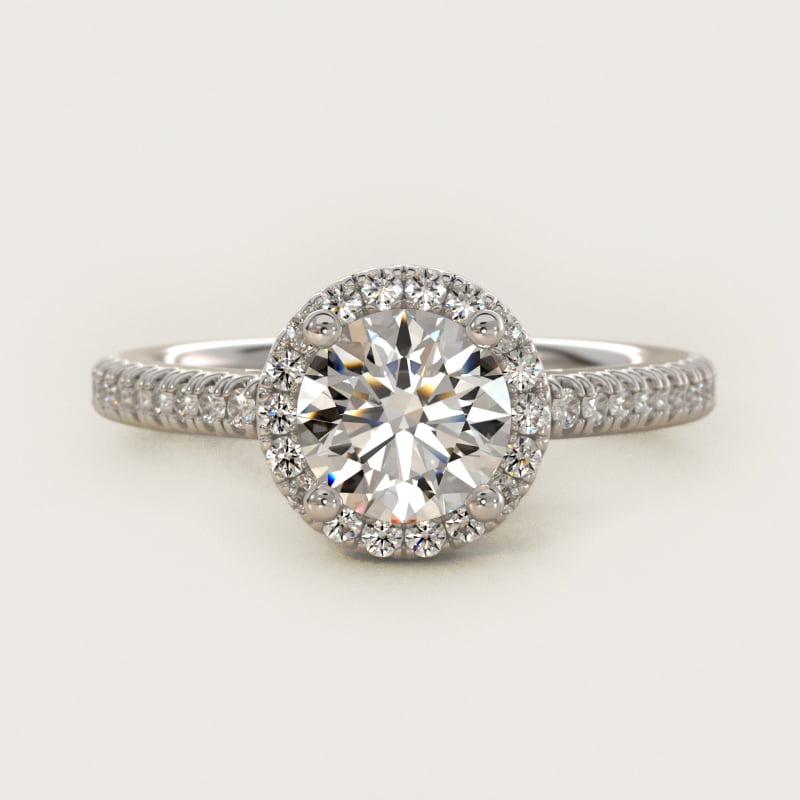
What moissanite actually is
Moissanite is a lab-made gemstone composed of silicon carbide. It was first found in a meteorite crater, but every moissanite sold today is grown in a laboratory, as natural moissanite is far too scarce to use. That makes it a diamond simulant: a stone designed to look like a diamond rather than to be one. This is an important distinction, and it is not the same as a lab-grown diamond, which is genuine diamond with the same carbon structure as a natural stone. If that is the option you are weighing, read our guide to lab-grown vs natural diamonds, because the comparison there is a different one altogether.
Sparkle and fire
This is where the two stones part company most visibly. Moissanite bends light more strongly than diamond, so it throws off noticeably more coloured flashes, often described as a rainbow or “disco ball” fire. Some people adore that extra display and choose moissanite for it. Others find it too much, a sparkle that reads as glassy or restless rather than refined, especially in larger stones under bright light. A diamond sparkles differently: it balances bright white light, or brilliance, with measured flashes of colour, and to most eyes that balance looks calmer and more classic. Neither is wrong; it is a matter of taste. The honest summary is that moissanite sparkles more, while a diamond sparkles more like a diamond.
Hardness and durability
Both stones are tough enough for daily wear, but diamond is harder. On the Mohs scale a diamond is a perfect 10, the hardest natural material known, while moissanite sits at roughly 9.25. Moissanite is therefore one of the most durable gemstones you can buy and will resist scratching well over a lifetime. A diamond, though, remains harder still, holds a crisp polish and faceting indefinitely, and is the stone we trust most for a ring that is meant to be worn every day and handed on.
How to tell them apart
To the naked eye, a good moissanite and a diamond can look similar at a glance, which is exactly why simulants exist. We cover the wider question in how to tell if a diamond is real; between these two stones, there are reliable tells:
- Fire: moissanite shows stronger, more colourful flashes, most obvious in bright light and in bigger stones.
- Double refraction: moissanite splits light in two, so looking through the top you may see facet edges that appear slightly doubled. Diamond never does this.
- Testing: a modern multi-tester distinguishes the two by their different properties, where an older diamond-only tester can be fooled, because moissanite also conducts heat.
- The certificate: a natural diamond comes with a GIA or HRD report you can verify yourself. Moissanite does not carry that kind of independent grading.
Price, value and resale
Moissanite costs a fraction of what a natural diamond of similar size costs, and we will never pretend otherwise. For a buyer who wants maximum visible size on a tight budget, that is a real and legitimate advantage. What changes the picture is value over time. A natural diamond is a scarce, enduring asset that holds its worth; we price ours transparently against the Rapaport benchmark, so you always know where a stone sits in the wider market. Moissanite, being manufactured in quantity, has little to no resale value once bought. You are paying for the look on the day, not for something that retains worth. That is the trade you are weighing, and it is the most important difference for anyone buying an engagement ring.
Moissanite vs diamond at a glance
| Natural diamond | Moissanite | |
|---|---|---|
| What it is | Natural crystallised carbon | Lab-made silicon carbide (a simulant) |
| Origin | Formed in the earth | Grown in a laboratory |
| Hardness (Mohs) | 10 | ~9.25 |
| Sparkle | Balanced brilliance and fire | Stronger, more colourful “disco” fire |
| Certification | GIA / HRD report you can verify | Not independently graded |
| Price | Higher | Far less |
| Holds value / resale | Holds its value | Little to no resale |
Common questions about moissanite and diamond
Is moissanite a fake diamond?
It is not a fake anything; it is its own gemstone, silicon carbide, sold under its own name. It only becomes dishonest when someone passes it off as diamond. Bought knowingly, it is a legitimate budget choice; sold deceptively, it is fraud, which is one more reason to insist on a certificate for any stone offered to you as a diamond.
Can you tell moissanite from a diamond by eye?
Often, yes, once you know what to look for. Moissanite throws stronger, more colourful flashes, and through the top of the stone its facet edges can appear faintly doubled because it splits light in two. Diamond never doubles. In a small stone under soft light the difference narrows, which is why testing and paperwork exist.
Does moissanite pass a diamond tester?
It fools older thermal testers, because it conducts heat much as diamond does. A modern multi-tester that also measures electrical conductivity separates them immediately. Any competent jeweller in Beirut carries one, and testing takes seconds.
Does moissanite get cloudy over time?
The stone itself does not degrade; it is very hard and chemically stable. Like any stone it dulls with skin oils and soap film, and its oily-looking lustre shows the film sooner than a diamond does. Regular cleaning restores it. What it cannot ever gain is what it lacked on day one: scarcity and an independent report.
Our honest view
Moissanite is a sensible budget choice, and we would never sneer at anyone who chooses it for the size and shine it offers. We simply deal in natural certified diamonds, because we believe a stone that is genuinely scarce, that holds its value, and that carries an independent report worth verifying is the better foundation for a ring you intend to keep. If that is what you are after, learn the 4Cs so every grade on a report makes sense, then browse our certified diamonds. Many couples find their answer in a 1 carat diamond, where a fine cut delivers the brilliance people remember long after they have forgotten the carat figure.